RF Microneedling for Acne Scars: Does It Work?
- Articles
Acne scars are among the most common reasons people seek RF microneedling, and they are also one of the concerns where it has the strongest support. The treatment works on the textured, structural nature of scarring rather than just the surface. This guide explains how, which scars respond best, and what to expect.
Does RF microneedling work for acne scars?
RF microneedling is one of the more effective non-surgical options for acne scarring, particularly indented (atrophic) scars. It combines micro-channels with controlled heat delivered into the skin, which breaks down scar tissue and prompts new collagen to rebuild the area more evenly. A systematic review of fractional radiofrequency microneedling for acne scars found supportive evidence for its use. Results build over a course, and a platform like POTENZA lets the depth and energy be matched to the scar type.
Why acne scars are hard to treat
Acne scars are not just surface marks. Indented scars form when the healing after inflammation pulls the skin down and leaves a loss of collagen beneath. Because the problem sits in the deeper structure, surface-only treatments often disappoint. Effective treatment has to reach the depth where the scar is anchored and encourage the skin to rebuild collagen there, which is exactly what RF microneedling is designed to do.
Disclaimer: This article is intended for general information and education only. It is not medical advice and does not replace a consultation with a qualified, licensed medical or aesthetic practitioner. Treatment suitability, settings and outcomes vary between individuals, so always seek a professional assessment before deciding on any aesthetic procedure. POTENZA is a registered trademark of Jeisys Medical Inc. and is a CE-marked device intended for use in dermatologic and electronic surgical procedures for electrocoagulation and hemostasis.
How RF microneedling targets scarring
The treatment works on two fronts at once. The fine needles create micro-channels and mechanically help break up the fibrous tissue that tethers a scar. At the chosen depth, radiofrequency energy then heats the area, which stimulates new collagen and elastin to fill and smooth it over the following months. Because depth is adjustable, the practitioner can sit the energy at the level of the scar, and because the surface is largely spared, recovery stays short. For deeper, more defined scars, a single-needle tip can deliver focused energy with surgical accuracy.
Which acne scars respond best
- Atrophic (indented) scars, including rolling and boxcar types, tend to respond well because the treatment rebuilds lost collagen.
- Ice-pick scars, which are narrow and deep, are harder and may need focused, single-needle approaches or a combination of treatments.
- Rolling scars often improve noticeably as the tethering is released and collagen fills the area.
- Raised (hypertrophic) scars and keloids are different. RF microneedling is generally not appropriate for keloid-prone skin, which is a contraindication.
Active, inflamed acne should be settled before treatment, since treating through a breakout is not advised. A practitioner will assess your scar type and skin before recommending a plan.
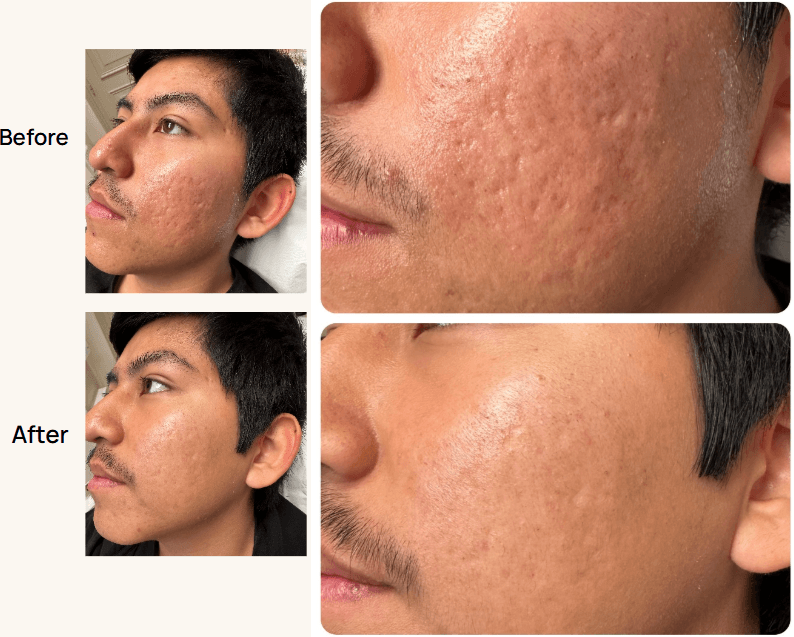
Results and timeline
Acne scarring improves gradually, not overnight. Most people need a course of around three to four sessions, sometimes more, spaced four to six weeks apart. Early texture changes can show within a few weeks, while the fuller improvement from new collagen develops over three to six months after the course. Scars are usually softened and made shallower rather than erased completely, and realistic expectations are part of a good result. Pairing the treatment with topicals such as polynucleotides during the session may support recovery, which a practitioner can advise on.
A note from the Jeisys Europe Team
Acne scarring is where control really earns its place. Different scars sit at different depths, so the ability to adjust needle depth, switch between focused and broader energy, and use a single-needle tip for stubborn individual scars makes a real difference to the outcome. This is the reasoning behind POTENZA’s range of tips and modes: scar treatment is rarely one setting applied uniformly, it is a tailored approach across the face. Honest expectations matter too, meaningful improvement is realistic, complete erasure usually is not.
Conclusion and next step
RF microneedling is a well-supported option for atrophic acne scarring, working at the depth of the scar to rebuild collagen and smooth the skin over a course of treatments. To see the outcomes practitioners report, view proven results with POTENZA.
Frequently asked questions on RF Microneedling in 2026
It usually softens and reduces the depth of scars rather than removing them entirely. Most people see meaningful improvement over a course, with realistic expectations being important, as complete erasure is uncommon with any single treatment.
Typically three to four sessions or more, spaced four to six weeks apart, because scars improve gradually. The exact number depends on the scar type and depth, which a practitioner assesses first.
It can help, particularly with depth-adjustable energy and focused single-needle tips for individual deep scars. Very narrow ice-pick scars are the hardest and may need a combination of approaches.
Active, inflamed acne in the treatment area should be settled first, as treating through a breakout is not advised. A practitioner will plan scar treatment once the skin has calmed.
Yes, generally, because the energy works below the surface and largely bypasses pigment. Conservative settings are used for darker skin to keep the small risk of pigment change low.