
RF Microneedling for Scars: Surgical, Traumatic and Hypertrophic Presentations
- Articles
Scar is a single word covering tissue that behaves in very different ways. An atrophic acne scar, a mature post-surgical line, a contracted traumatic scar and a raised hypertrophic scar differ in collagen architecture, thickness and vascularity, and they respond differently to controlled thermal injury. Treating them with one protocol is the most common reason RF microneedling underperforms in this indication.
This article separates the presentations that matter for treatment planning and sets out the parameter decisions, timing and counselling that follow. Atrophic acne scarring is covered in detail in our dedicated article on RF microneedling for acne scars.
Why Fractional RF Suits Scar Tissue
Scar tissue is remodelled, not removed. Fractional radiofrequency delivers energy through the needle array into the dermis, producing discrete columns of controlled coagulation surrounded by untreated tissue. Those spared columns are what make the approach viable: they provide the reservoir of healthy tissue from which repair proceeds.
Because energy is delivered through needles rather than absorbed by a surface chromophore, the mechanism is largely independent of epidermal pigment. That matters in scar work, where many patients present in higher Fitzpatrick types and pigmentary risk with chromophore-dependent modalities is real.
Scar Categories and What Each Requires
Atrophic acne scarring. Depressed scars from collagen loss. The objective is neocollagenesis and dermal thickening beneath the depression, with tethering release where scars are bound down.
Surgical and post-operative linear scars. Usually narrow, often widened or depressed. The objective is collagen reorganisation along and beneath the line, softening the demarcation with surrounding skin. Planning must account for the plane of the scar, any underlying hardware or graft, and the site.
Traumatic scars. The most variable category. These may be irregular, contracted, adherent to deeper structures, or mixed atrophic and hypertrophic within one field, so mapping before treating is more useful here than anywhere else.
Hypertrophic scars. Raised but confined to the original wound boundary. The objective reverses from building volume to reducing it: controlled dermal coagulation to break down excess collagen and soften the raised profile.
Keloids. Raised scars extending beyond the original boundary, driven by a distinct fibroproliferative process. RF microneedling is not first-line for active keloid disease, and keloid-prone patients require careful counselling before any energy device is used.

Depth, Density and Insulation
Depth against scar thickness and site. Depth follows the thickness of the tissue being treated and the anatomy beneath it, not a standard facial protocol. Thick hypertrophic tissue on the sternum requires different depth from a fine periorbital scar, where the safety margin is narrow. Where thickness varies across a field, depth should vary with it.
Density against tissue reserve. Higher needle counts spread energy superficially across a wider area; lower counts concentrate it more deeply. In compromised tissue, a lower-density, deeper approach with more spared tissue between columns is generally more forgiving.
Insulation and epidermal sparing. Insulated tips deliver energy only at the needle tip, keeping the thermal effect in the dermis. Over a mature scar with thin, atrophic or dyspigmented epidermis, that sparing is usually the priority. Semi-insulated tips treat superficial and deep dermis at once, which can suit thickened or sebaceous scar tissue. Our article on insulated and semi-insulated needles covers the distinction in full.
Timing Relative to Wound Healing
Treating too early is a common and avoidable error. A scar that is still red, raised and actively remodelling is not a stable target, and intervening during active inflammation adds thermal injury to tissue already inflamed.
Conventional practice is to allow the scar to mature and the wound to be fully closed and stable, with the interval judged on the individual scar rather than the calendar. Settling erythema, softening and the absence of any ongoing wound issue are more useful indicators than a fixed number of months. Recent radiotherapy to the field, ongoing infection or an unresolved surgical complication are all reasons to defer.
Course Length, Intervals and Expectations
Scar remodelling is slow, and collagen continues to reorganise for months after treatment. The visible endpoint of a course is not reached at the final session, and patients need to understand this before starting.
- Scar indications generally require a longer course than rejuvenation, with intervals allowing remodelling between sessions.
- Improvement is measured in softening, flattening, pliability and colour match rather than in disappearance.
- Older, mature scars typically respond more slowly, and dense fibrotic tissue may plateau.
- Standardised photography at consistent lighting, distance and angle is the only reliable way to demonstrate slow change to a patient who sees their scar daily.
Consent should be explicit about the number of sessions likely to be required, the gradual nature of the change, the pigmentary risk in higher Fitzpatrick types, and the patient’s own history of hypertrophic or keloid scarring, which predicts how they may respond.
Combined approaches are common in practice. Where scar treatment sits alongside injectables, resurfacing or intralesional therapy, the sequence and the intervals should be planned at consultation rather than improvised session by session.
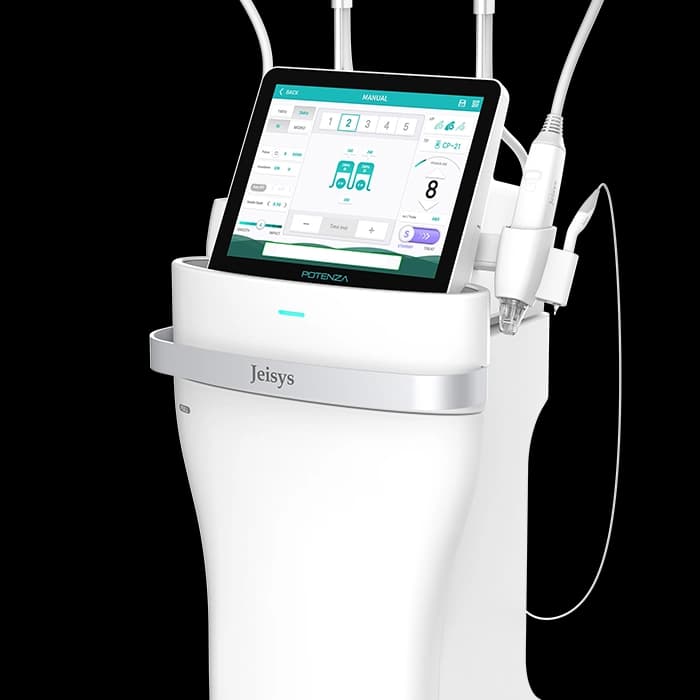
See the full POTENZA tip range and our proven results on our website, and register for the Jeisys partner portal for indication-specific protocol documentation and clinical support.
Frequently Asked Questions
Fractional RF is used on mature surgical scars with the objective of reorganising collagen along and beneath the scar line, softening the demarcation with surrounding skin. Response varies with the age of the scar, its site and individual healing. It is a remodelling approach delivered over a course rather than a single corrective procedure.
The tissue objective is reversed. In atrophic and contracted scars the aim is neocollagenesis and dermal thickening beneath the depression. In hypertrophic scars the aim is volume reduction and softening through controlled dermal coagulation, so depth and density are selected accordingly.
It is not a first-line treatment for active keloid disease, which is driven by a distinct fibroproliferative process and usually managed through established medical and surgical pathways. Any patient with a history of keloid or significant hypertrophic scarring requires careful counselling, including the possibility that treatment provokes a scarring response.
The wound must be fully closed and stable, and the scar should have matured. The interval is judged on the individual scar using settling erythema, softening and the absence of any ongoing wound issue rather than a fixed number of months. Treating an actively inflamed scar is a common cause of poor outcomes.
Insulated tips are generally preferred where the overlying epidermis is thin, atrophic or dyspigmented, because energy is delivered only at the needle tip. Semi-insulated tips can suit thickened or sebaceous scar tissue where a superficial component is also required.
Disclaimer
This article is intended for educational purposes for healthcare professionals and does not constitute clinical advice or a treatment protocol. POTENZA is a CE-marked device indicated for use in dermatologic and general surgical procedures for electrocoagulation and haemostasis. Individual results vary and no outcome is guaranteed. All treatment decisions, parameter selection and patient suitability remain the responsibility of the treating clinician, working within their scope of practice and applicable national regulation.