
Operator Technique in RF Microneedling: Passes, Overlap and Endpoints
- Articles
Give two clinicians the same device, the same tip and the same parameters, and the results will differ. Sometimes considerably. The device is identical, the settings are identical, and the variable that remains is technique.
Device capability sets the ceiling on what is achievable. Operator technique determines how close a clinic gets to it, and it is the largest uncontrolled source of outcome variation in RF microneedling. This article covers the variables that account for most of it, and they are all things the operator does with their hands: pass planning, overlap discipline, insertion technique and endpoint recognition.
Pass Planning and Treatment Mapping
A face is not one tissue. Periorbital skin, the mid-cheek, the perioral region, the jawline and the forehead differ in thickness, sebaceous density, vascularity and underlying anatomy. Treating all of them at a single full-face setting means part of the field is receiving parameters chosen for tissue it does not resemble. Our overview of how RF microneedling works and our article on the science of heat and needles cover the underlying thermal behaviour.
Zone-by-zone planning addresses this. Before starting, the field is divided into zones with a defined depth, density and mode for each. In practice this takes a minute and removes most of the improvisation that otherwise happens mid-pass. Mapping serves a second purpose: a field that has been visually divided is far easier to treat systematically, which is the foundation of overlap control.
Overlap Discipline
Overlap is the most consequential technique error in RF microneedling, and the mechanism is worth understanding rather than simply avoiding. When a second pass is delivered into tissue that has already received one, the thermal load is cumulative. The tissue is already at an elevated temperature, its impedance has changed, and its capacity to dissipate further heat is reduced.
The second pass therefore delivers more effect into tissue less able to tolerate it. This produces grid or tram-track marking where the boundaries between passes have been double-treated, following the geometry of the array rather than the anatomy of the face, and raises the risk of prolonged erythema, epidermal injury and post-inflammatory hyperpigmentation, all covered in our article on managing RF microneedling complications.
Prevention is procedural rather than technical: work systematically within a mapped zone, complete a zone before moving on, use anatomical landmarks as boundaries, and treat the edges of each zone as the place where attention is most needed.

Insertion Technique
Consistent insertion is a dose-control issue. The needle array is an electrode, and how it sits in tissue determines the geometry of the current path. Incomplete insertion, an oblique approach or inconsistent skin tension all change that geometry, so delivered dose differs from the intended one even though the parameters have not changed.
- Perpendicular approach. The array should meet the skin at ninety degrees so all needles reach the intended depth. On curved surfaces this requires deliberate repositioning of the handpiece rather than a change of wrist angle.
- Skin tension. Consistent, moderate tension supports full insertion. Too little allows the skin to tent and the needles to under-insert; too much distorts the tissue and changes the depth achieved.
- Full contact before delivery. Partial contact means partial insertion, and a different current distribution from the one the parameters assume.
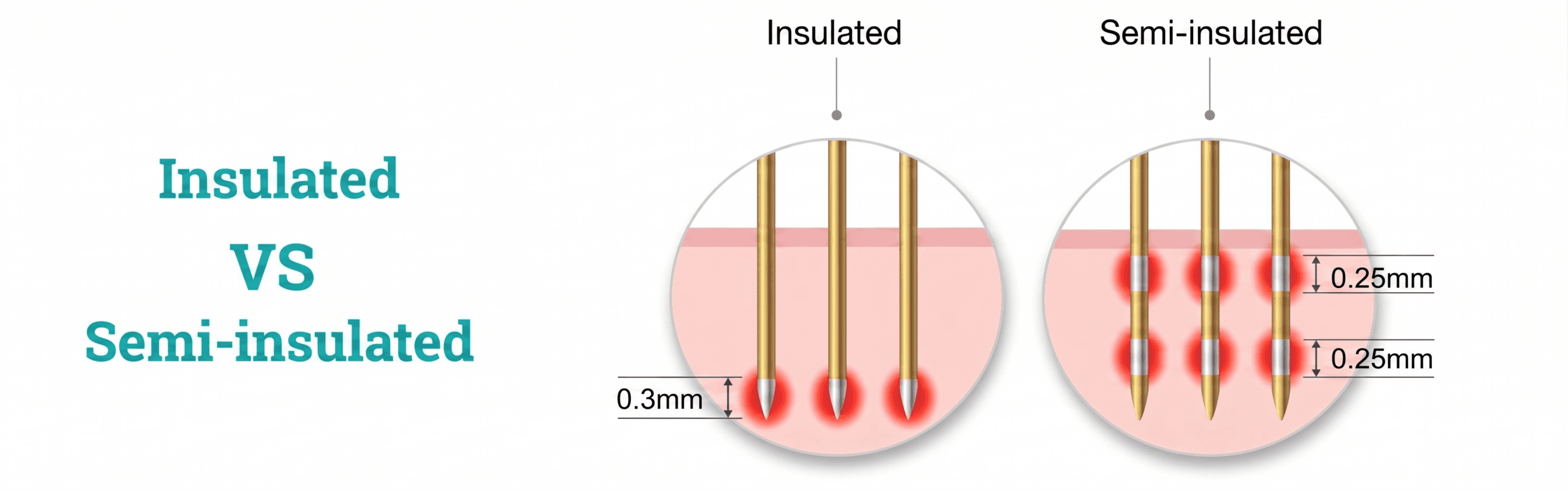
- Consistency across the field. Parylene-coated needles present less friction on entry, which keeps delivered dose stable from the first zone to the last across several hundred insertions.
Clinical Endpoint Recognition
Knowing when to stop is a skill, and it is taught less often than it should be. The endpoint differs by indication, so treating every indication to the same visual endpoint means at least some are being over- or under-treated.
The first common error is treating to visible erythema alone. Erythema is a surface response and a poor proxy for what is happening at depth. A pass that produced satisfying redness may have delivered its energy too superficially, and one that produced modest redness may have delivered exactly what was intended into the deep dermis.
The second is escalating energy to chase an endpoint that depth should be delivering. If the intended effect is not appearing, the first question is whether the energy is landing in the right tissue layer, not whether there is enough of it. Increasing energy at insufficient depth concentrates more heat in the epidermis and is a direct route to marking and pigmentary change. Define the endpoint for the indication before starting, and change depth before changing energy.
Why Energy Alone Is an Unreliable Proxy
All of the above assumes the energy selected is the energy delivered, and it is not. Tissue impedance varies between patients, between sites and across a single field as hydration and temperature change during a session, so the same setting produces a different delivered dose in different conditions. Our article on why the same settings behave differently on different skin covers that mechanism and how real-time impedance monitoring addresses it.
The technique consequence is simple. When the intended endpoint is not appearing, escalating energy is rarely the right correction, because energy is the variable you can see and depth, insertion and delivered dose are the ones actually determining the result.
Building Consistency Across a Clinic
Where more than one operator uses a platform, technique variation becomes a clinic-level issue. Documented zone maps and parameter records per indication, structured training on insertion and endpoint recognition, standardised photography, and a habit of reviewing outcomes against recorded parameters are what turn a good device into consistent results across a team.
Read our tip selection article, browse the full POTENZA tip range and explore the platform technology. Register for the Jeisys partner portal for training pathways and protocol documentation, which is where the parameter records for each indication live.

Frequently Asked Questions about Operator Technique in RF Microneedling
Substantially. With the same device, tip and parameters, outcome variance between operators is significant, and most of that variance is technique rather than equipment. Pass planning, overlap discipline, insertion consistency and endpoint recognition are the largest uncontrolled variables in the treatment.
Pass count is set against the indication, the zone and the parameters rather than as a fixed number, because each additional pass adds cumulative thermal load to tissue whose impedance has already changed. Where the intended endpoint is not being reached, reviewing depth is more appropriate than adding passes.
Overlapping passes at the boundaries between treatment areas. Tissue that has already received a pass is at an elevated temperature with altered impedance and reduced capacity to dissipate heat, so a second pass delivers more effect into tissue less able to tolerate it. Zone mapping and systematic working prevent it.
The endpoint differs by indication and should be defined before treatment begins rather than judged in the moment. Two common errors are treating to visible erythema alone, which is a poor proxy for dermal effect, and escalating energy to chase an endpoint that depth should be delivering.
A face is not one tissue, so a single full-face setting means part of the field receives parameters chosen for tissue it does not resemble. Dividing the field into zones with a defined depth, density and mode for each takes about a minute and removes most mid-pass improvisation. It is also the foundation of overlap control, since a field that has been visually divided is far easier to treat systematically.
Disclaimer
This article is intended for educational purposes for healthcare professionals and does not constitute clinical advice or a treatment protocol. POTENZA is a CE-marked device indicated for use in dermatologic and general surgical procedures for electrocoagulation and haemostasis. Features and configurations may vary by market. Impedance monitoring supports consistency of energy delivery and does not replace clinical judgement, correct depth selection or operator technique. All parameter selection and patient suitability decisions remain the responsibility of the treating clinician, working within their scope of practice and applicable national regulation.